Every practice you acquire
already does the work.
Almost none of them
bill for it.
If you are consolidating neurology practices right now, you are early to something the rest of healthcare has not fully noticed yet. You are also buying a very specific asset, and it is worth being precise about what it is.
You are not buying visit volume. Visit volume is capped by the scarcest input in the entire specialty — a neurologist's hours — and it does not get cheaper with scale. What you are actually buying is panels: thousands of patients with progressive, multi-year, comorbidity-dense neurological disease, each of whom generates a continuous stream of coordination work between visits.
That coordination work is real. Your practices are doing it today. In almost every practice we have looked at, they are doing it for free.
You Bought Panels. Panels Have Two Revenue Lines.
There are two ways a neurology practice earns. Most MSO operating models are built almost entirely around the first one, and treat the second as a rounding error or a someday project. In neurology specifically, that ordering is backwards.
Bounded by clinician hours and clinic capacity. Grows when you add providers or add sites — which is to say, when you spend money.
Bounded by enrollment and documentation, not by clinician hours. Compounds with every patient enrolled and every practice added — and every practice you buy arrives with a panel already full of eligible patients.
CMS has been paying for line two for years. Four distinct programs cover it — Chronic Care Management for patients with two or more chronic conditions, Remote Patient Monitoring for device-based physiologic data, Principal Care Management for a single high-complexity condition, and Remote Therapeutic Monitoring for therapy adherence and response data. Each one has published codes, published time thresholds and published documentation requirements. None of them is a pilot, and under Medicare none of them requires a contract to be negotiated first — though coverage across commercial and Medicare Advantage plans does vary, so it is worth testing against your own payer mix.
What each of them does require is proof: documented consent, a documented care plan, and documented clinical staff time attributable to a specific program in a specific month. That is the whole game. The clinical work is not the constraint. The evidence of the clinical work is the constraint.
In a neurology practice, line two is not new work you have to go create. It is existing work you are currently giving away — and the gap between those two framings is the difference between a two-year build and a ninety-day capture.
Dementia Is the Best Care Management Population in American Medicine
Take any list of the attributes that make a population ideal for chronic care management, and the dementia panel scores near the top of every one.
- Eligibility is nearly automatic. CCM requires two or more chronic conditions expected to last at least twelve months. A dementia diagnosis is one; the hypertension, diabetes, depression, hyperlipidemia or atrial fibrillation sitting alongside it in the chart supply the rest. Very few patients on a memory clinic panel fail the test.
- The coordination burden is genuinely high. Medication reconciliation, caregiver instruction, fall risk, behavioral changes, transitions after every hospitalization, driving and safety conversations, advance planning. This is not manufactured activity to justify a code.
- The horizon is long. Neurodegenerative disease does not resolve. A patient enrolled today is very often still enrolled thirty-six months from now — which is precisely what makes the revenue recurring rather than episodic.
- The clinical case and the billing case point the same direction. These programs reimburse exactly the proactive coordination that reduces crises, ER visits and avoidable admissions in this population. You are not gaming anything. You are being paid for the thing you would want done anyway.
7.4M
Americans age 65+ living with Alzheimer's in 2026 — the panel your practices already hold.
Nearly doubling by 2060. Endpoints are published; the curve between them is interpolated for shape only.
4
separate CMS programs already paying for between-visit care under Medicare — no contract to negotiate first.
Published codes, published thresholds, published documentation rules. None of them is a pilot.
20min
of documented clinical staff time per month clears base CCM — the bar is time you can prove, not time you spent.
A single dementia household clears it three times over. The ledger further down shows how.
Sources listed at the end of this article. We have used only figures we could trace to a primary source, and labelled the rest as what it is: modelling and judgment.
So if the population is this good and the programs have existed this long, the obvious question is the interesting one.
And the Worst Fit for Care Management Software Built for Anyone Else
Here is the paradox at the centre of this entire opportunity, and it is the reason the revenue is still sitting there for you to take rather than already competed away.
The patients who need care management most are the least able to participate in it.
Every mainstream care management platform in the market makes one foundational assumption: that the patient is the participant. The patient consents. The patient answers the outreach call. The patient downloads the app, pairs the blood pressure cuff, reports the symptom, remembers the appointment. Strip that assumption out and most of these systems have nothing left to stand on.
A patient with moderate Alzheimer's disease cannot reliably do any of it. In neurology, care management is not a two-way relationship between practice and patient. It is a three-way relationship between the practice, the patient and the caregiver — and the caregiver is frequently the daughter, three states away, who works full time and is the only person who actually knows which medications were taken this week.
Software that treats the caregiver as an emergency contact instead of a primary user does not merely perform worse in this population. It fails structurally, in five specific and predictable places.
This is why the money is still on the table. It is not that neurology practices are unaware of CCM. It is that they tried it with tools designed for a diabetic who answers the phone, watched it produce almost nothing, and reasonably concluded the programs were not worth the trouble.
What “Tailor-Made for Dementia” Has to Mean
Every vendor in this market will tell you they support neurology. Ask them what they changed. In most cases the answer is a specialty dropdown and a different set of ICD-10 codes on the same primary-care chassis.
We built the model the other way around — starting from the dementia patient and the person who actually manages their life, and working outward. Four things follow from that starting point, and they are not cosmetic.
Not an emergency contact on a form. A named participant with permissioned access, their own communication channel, their own tasks and their own escalation path — because in this population the caregiver is who reports the symptom, manages the medication and answers the phone. Design for who is actually there.
Care coordination time is captured as the work happens — calls, secure messages, care plan updates, device alerts reviewed — and attributed to the correct program automatically. Nobody bills from memory at month end, and no clinical minute goes uncounted because someone was too busy caring for a patient to log it.
Which activity counts toward CCM, RPM, PCM or RTM. Which combinations conflict. Which patients are short of threshold with days left in the month, and which are enrolled but not yet consented. Compliance and capture are the same mechanism, running continuously, instead of two arguments held after the fact.
A dedicated dementia AI agent supports caregivers with behavioural strategies and plain-language guidance around the clock; communication routes to the person capable of acting on it; monitoring leans on passive signal — including fall detection — rather than on a patient's memory. Engagement that assumes intact cognition is not engagement.
What a month actually looks like
The reason this matters commercially is volume. A dementia household is not a low-touch relationship — it is one of the highest-touch relationships in ambulatory medicine, and almost all of it happens between visits. Here is a single patient in a single ordinary month.
Illustrative composite, no patient data. Seven interactions, four of them directly with the family rather than the patient, and not one of them an office visit. In a practice running generic care management software, the count for this month is zero — not because the work didn't happen, but because it happened on a cell phone, in a text thread and in a hallway, addressed to a person the software does not recognise as a user.
That is the whole thesis in one graphic. The base threshold was cleared by the second entry, and three times over by month end. Whether any of it is worth anything depends entirely on whether the caregiver was a first-class user of a system that was counting.
Generic CCM does not under-perform in dementia. It scores zero on the majority of the month's actual work — because the majority of that work is a conversation with somebody the software never enrolled.
The AI Layer: Three Users, Not One
The volume above cuts both ways. Seven meaningful interactions per patient per month is excellent revenue and an impossible workload — multiply it by a panel of three hundred and you have simply moved the bottleneck from the neurologist to the care manager. Enrollment depth stalls not because patients are unwilling but because your staff runs out of hours in the third month.
This is where the AI layer earns its place, and it has to serve all three corners of the triad — not just the one that shows well in a demo.
Specialist agents handle the preparation and the paperwork around the clinical judgement, so the human minutes go to the family instead of the keyboard.
- Care plan designer drafts and updates the structured plan
- Lab results analyst interprets and trends the panel
- Prior authorisation agent assembles drug-specific justification
- Conversation summaries turn a month of messages into a note
- Triage agent sorts what needs a person today from what can wait
Engagement that assumes an intact memory is not engagement. Support is plain-language, repeatable without impatience, and available in the language actually spoken at home.
- Plain-language reinforcement of what was said in clinic
- Answers the same question a fourth time without a sigh
- English and Spanish, reviewed for clinical context
- Routes to the caregiver when the patient cannot act
A dedicated dementia agent supports the person who is actually managing this illness — the one currently googling at midnight and calling your office on Monday, or taking her father to an emergency room she did not need to.
- Behavioural strategies for agitation, sundowning, refusal
- “Is this normal, or do I call someone?” — answered, 24/7
- What to watch for between infusions on anti-amyloid therapy
- Escalation to a human with the context already attached
And the agents consult each other. A dementia question that turns on a medication interaction, a lab trend or a nutrition issue is passed to the specialist peer agent rather than answered badly — and every agent is reading real-time patient data, not just a transcript. That is the difference between clinical intelligence and a chatbot with a specialty label on it.
One point of candour, because it matters for how you model this: an AI interaction is not billable clinical staff time, and we will never tell you otherwise. What the AI layer does is more valuable and less exciting than that. It absorbs the volume that would otherwise consume your staff, it captures and structures every interaction as it happens so the qualifying human minutes are documented rather than remembered, and it lets one care manager hold a materially larger panel without the quality falling over. In the model further down, that is the difference between enrolling twenty-five patients per physician and enrolling fifty.
Underneath all of it sits the same protocol engine that runs our infusion and oncology work — because a dementia panel is rarely only a dementia panel any more. Which brings us to the second, larger bet.
The Second Bet: Anti-Amyloid Readiness Is an MSO-Scale Problem
Two disease-modifying anti-amyloid therapies are now FDA-approved and commercially available. Real-world uptake has been slow, and the comfortable explanation — that neurologists are clinically skeptical — does not survive contact with the practices themselves.
The barrier is operational. Putting one patient on therapy requires eligibility confirmation and amyloid testing, APOE genotyping, a baseline MRI, prior authorization against payer-specific criteria, an infusion schedule that holds for months, a surveillance MRI schedule for ARIA that is not optional, symptom vigilance between infusions, and a caregiver who understands what to watch for. Miss one gate and the protocol is broken. We wrote about this at length in The Real Barrier to Anti-Amyloid Adoption.
A solo practice cannot build that capability. A ten-practice platform can build it once and deploy it ten times — and that asymmetry is, in plain terms, the reason MSOs exist. This is one of the few places where the holding company is genuinely the right unit of solution rather than an overhead layer.
- The capability lives in one nurse who learned it the hard way
- Referring physicians can't predict which of your sites can actually deliver
- A missed surveillance MRI is discovered after the fact, not before the infusion
- Prior auth is re-learned per payer, per site, per patient
- The high-complexity patient gets referred out — along with the downstream revenue
- Nothing an acquired practice learns transfers to the next acquisition
- The protocol lives in the system — it survives a resignation and a Tuesday
- Every site delivers the same standard, so the brand means something
- Imaging and infusion gates are enforced before the appointment, not audited after
- Payer criteria and PA documentation are institutional knowledge, not tribal
- Complex patients stay inside the network — infusion, imaging and follow-up included
- Practice number eleven goes live on day one with practice number one's playbook
The other burden nobody demos: getting paid for it
Everything above is about the clinical protocol. There is a second protocol running alongside it that gets far less attention and destroys far more money, and it lands on exactly the same people. These are five- and six-figure claims. When one goes wrong, it does not bounce back as a polite question — it becomes a denial, an appeal, a write-off, and a very awkward line in a monthly review.
Consider everything that has to be simultaneously true before a single anti-amyloid dose becomes a clean claim.
Eight things, all true at once — or the money doesn't arrive.
Hover any condition to watch the claim fail →
Not one of those is difficult. All of them, on every dose, for every patient, held in the working memory of the person who is also running an infusion chair and calling a family back — that is the cognitive burden. And it is why high-cost neurology claims quietly get written off instead of fixed: not because anyone was careless, but because nobody can hold eight moving states in their head sixty times a week.
This is the part of the platform that is least interesting to demo and most valuable to own. The system holds the state, not the staff. Authorisation has an expiry and a next action weeks ahead of it. Units derive from the dose that was actually administered rather than from what someone remembers. The imaging gate is linked to the dose it gates, so the evidence assembles itself. The site-of-care code set follows the site. And the exception — the one dose out of sixty where something is missing — surfaces before the appointment rather than in a denial letter eleven weeks later.
Ask your infusion managers what they lie awake about. It is almost never the clinical protocol — they know that cold. It is the fear that something administrative slipped on a $30,000 dose and nobody will find out for two months. Removing that is not a billing feature. It is the difference between a program your operators are willing to scale and one they quietly cap.
And note where this class is heading, because it changes the shape of the problem rather than the size of it. With subcutaneous lecanemab dosing now approved, part of anti-amyloid therapy is moving out of your chair altogether. None of the surrounding discipline moves with it: the baseline and surveillance MRI gates, the ARIA vigilance, the coverage criteria and the caregiver education are all exactly where they were. What changes is that more of it now happens in a house you cannot see into. A network whose anti-amyloid capability is really just an infusion suite gets weaker as this shifts; a network whose capability is a monitoring and protocol standard gets stronger, because the part it owns is the part that just became harder.
There is a strategic dimension here too. Therapy manufacturers have a direct commercial interest in removing the operational friction that keeps eligible patients off treatment — that is exactly what hub and practice-enablement programs exist to do. A neurology platform that can demonstrate reliable protocol execution across dozens of sites is a materially more interesting partner to them than any single practice can ever be.
One Infusion Standard, Every Chair, Every Site
And anti-amyloid is only the newest arrival. Look at what is already flowing through the infusion suites in a neurology portfolio: MS biologics, immunoglobulin for CIDP and myasthenia gravis, CGRP therapies for chronic migraine, ALS infusions, and now anti-amyloid on top. Your infusion footprint is quietly the most capital-intensive, most protocol-dependent and most margin-sensitive asset you own — chairs, pharmacy, nurses and a schedule that has to hold.
Here is the operational reality in almost every multi-site group we have looked at. Ask four sites how they run the same therapy and you get four answers, all of them defensible, none of them written down in the same place:
- Different pre-medication and pre-check practice, because each site's protocol reflects whoever set it up and what they were taught.
- Different reaction response — observation periods, rate adjustments and escalation thresholds that vary by nurse rather than by policy.
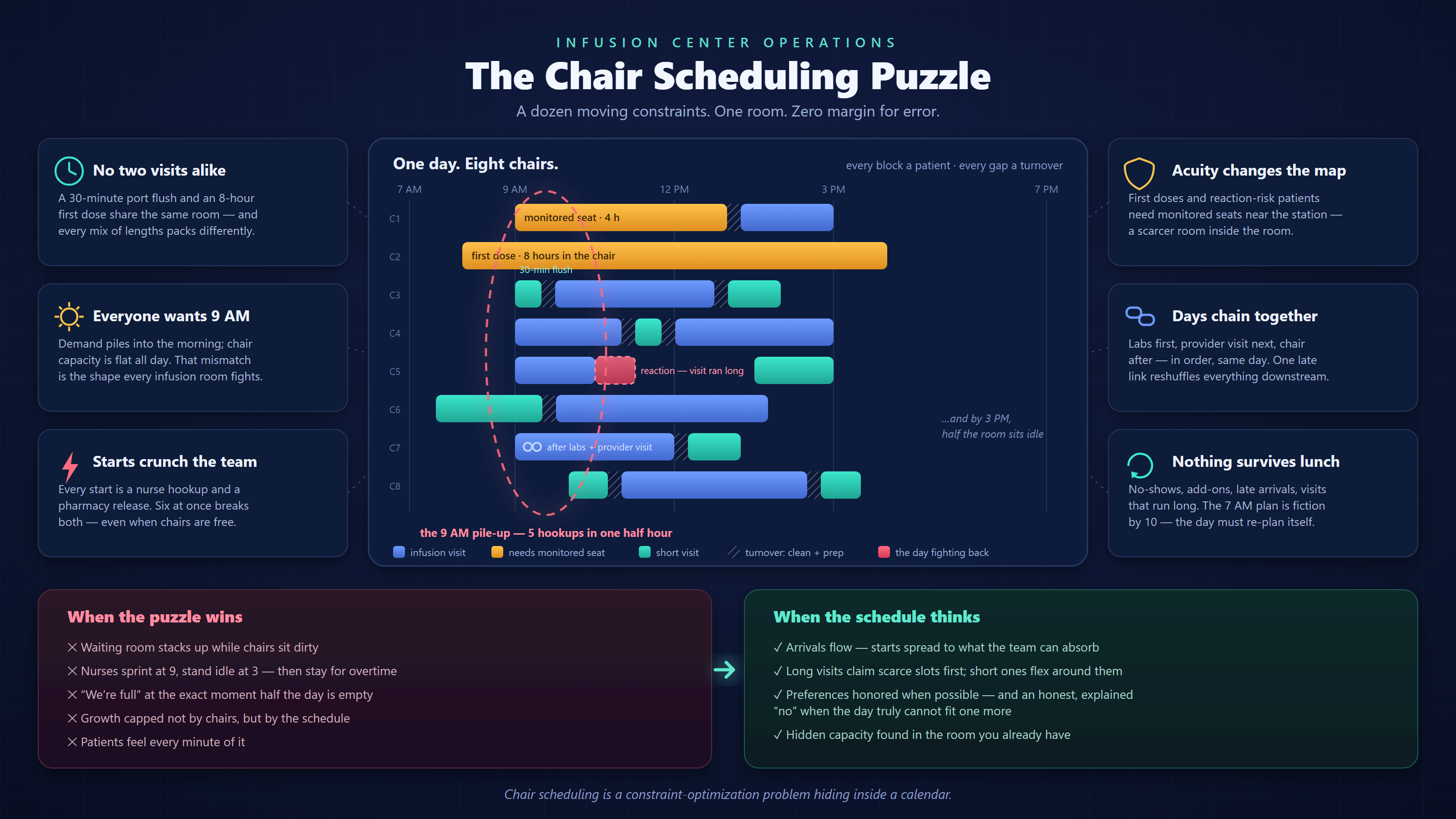
- Different chair-time assumptions, so the same therapy is booked for ninety minutes at one site and three hours at another, and nobody can compare utilisation.
- Different prior authorisation playbooks, re-learned per payer, per site, per patient.
- Different documentation, which means portfolio-level reporting is an exercise in reconciling four spreadsheets rather than reading one view.
Every one of those is survivable inside a single practice. None of them is survivable as an acquisition strategy, because the divergence compounds with every site you add — and it is exactly the thing a holding company is supposed to eliminate.
The rails are constant. Only the payload changes.
The good news is that infusion standardisation is far more tractable than it looks, because the therapies differ enormously while the operational discipline barely differs at all. Six rails carry every infusion your network delivers. What changes between therapies is what gets loaded onto them.
Illustrative and simplified for clarity — not clinical guidance. Read down a column and you see four very different therapies. Read across a row and you see one operating standard. The columns will keep changing as new neurology biologics launch; the six rails on the left will not.
That is what makes this a platform problem rather than a practice problem. If the rails live in a system, a new therapy is a configuration — a protocol pack loaded onto rails that already exist, deployed to every site at once. If the rails live in people, a new therapy is eleven separate implementation projects, run at eleven different speeds, with eleven different results.
A referring neurologist, hospital or health plan sending you a complex patient is making a bet on execution. When every site delivers a demonstrably identical standard, that bet becomes easy — and the referral goes to the network rather than to whichever individual doctor someone happens to trust.
Standard chair-time assumptions and one scheduling view mean utilisation is finally comparable across sites — which is the precondition for load-balancing a patient to the suite with capacity on Tuesday instead of pushing them out four weeks at the one they always attend.
Sites that cannot confidently run a protocol refer the hardest patients out — and the drug margin, the imaging, the follow-up and the care management revenue leave with them. Capability parity across sites is retention, expressed as an operating standard.
The neurology pipeline is not slowing down. When the next therapy arrives, a network with the rails already built loads the protocol pack and goes live everywhere at once — which is precisely the capability that makes you interesting to the manufacturer launching it.
Standardisation here does not mean taking clinical judgement away from your physicians. It means that the things which should never vary — the gate before a dose, the response to a reaction, the evidence behind a claim — stop varying, so that the things which should vary have room to.
This is the same engine described earlier, pointed at a different problem. Pre-checks as enforced gates, surveillance that continues between visits, authorisation and documentation riding along with the protocol — and one portfolio-level view of which patients at which sites are on protocol, off protocol, or about to be. We wrote about why fragmenting that across six vendors becomes a safety problem rather than merely an inconvenience in Six Vendors, One Patient.
The Integration Clock: Where This Actually Shows Up
Care management revenue is not really a clinical initiative in an MSO. It is an integration capability. The question is not whether CCM works — it demonstrably does — but how many days after close it starts working, and whether the answer is the same for practice eleven as it was for practice one.
That last row is the one worth dwelling on. A capability that has to be rebuilt at every site is an operating expense. A capability that deploys by configuration is a reason the platform is worth more than the sum of the practices in it — which is, presumably, the entire premise you are underwriting.
“Fine — but every practice we buy has a different EHR.”
This is the first question we get from anyone who has actually run an integration, and it deserves a straight answer rather than the word “interoperability.”
We do not replace the EHR. The platform runs alongside it and the system of record stays the system of record — which is the only version of this that survives contact with a physician who has spent four years learning their chart. What we integrate is a deliberately narrow surface, because the surface that matters for care management revenue is genuinely small: get the panel in, and get the monthly documentation back out to where the practice already works.
Concretely, at the neurology group described above we are integrated with Epic, exporting each patient's monthly CCM summary directly into the EHR. The documentation that substantiates the claim lands in the chart automatically — nobody re-keys it, nobody rebuilds it at month end, and the record a payer would eventually ask to see is sitting where an auditor would expect to find it. That is a narrow integration and we would rather describe it accurately than dress it up as something larger.
The narrowness is the point. A migration is a quarter-long project with a change-management problem attached; a summary export is not. It is the reason a new site can be counted in weeks rather than in budget cycles — and it is also the honest limit of the claim. Each EHR is its own piece of work, we scope it per site, and in any conversation with you we will be specific about what we have built already and what we would be building for the first time.
The test worth applying to any vendor here is not “do you integrate with Epic?” — everyone says yes. It is “show me the artefact that lands in the chart, and tell me who re-types it when it doesn't.” That question separates a working integration from a slide in about ninety seconds.
The Portfolio Argument, With the Assumptions Showing
We are not going to hand you a projection. Reimbursement for care-management programs varies by geography, code mix, program depth and year, and any dollar figure we published here would really be a number about someone else’s practice. What we can do is name the variables that decide the outcome — and be honest about which one is fragile.
There are three. The rate per enrolled patient per month, which is set by the fee schedule and not by us. The number of physicians across your portfolio, which you already know. And enrollment depth — enrolled, consented, documented patients per physician per month. Not eligible patients. Enrolled ones.
Now the honest part, because it is the part that determines whether any of the above happens: the fragile variable is enrollment depth. The rate is published and the physician count is on your cap table. Enrollment depth is where every one of these programs lives or dies — and enrollment depth in a dementia panel is precisely what breaks when the consent workflow cannot handle a surrogate and the outreach is addressed to a patient who cannot respond.
Which is the whole argument of this piece. The dementia-native design is not a nicer user experience. It is the variable that decides whether column one or column three is the one you actually get.
And it is worth saying plainly: this work is recurring and panel-driven, and it is designed to be carried by the team you already have. In a portfolio being underwritten on durable earnings, that is a different kind of revenue — not merely more of the kind you already have.
Battle-Tested — and the Honest Size of It
None of this is a whiteboard exercise for us. Our care management model was built for dementia and hardened in a real neurology practice, in production, with real patients and real caregivers — not adapted from a primary-care product after the fact.
A 20-physician neurology group enrolls 85% of its dementia panel in billable care.
— In production today; practice anonymous
The honest framing: this is one group, not fifty, and we would rather you hear that from us than discover it in diligence. The group reports no missed protocol checkpoints to date across those patients — their number, over a single site, not independently audited, and we would treat any vendor quoting perfect figures on a panel this size with the scepticism it deserves, ourselves included. What it does mean is specific: caregiver-first enrollment, surrogate consent, automatic time capture and enforced imaging gates are running in a live neurology practice today, not sitting in a roadmap. We have also had inbound interest from a therapy manufacturer on practice enablement. The next chapter is scale, and we are looking for a small number of partners to build it with rather than a long list of logos — and we will introduce you to the group above so you can ask them directly.
The Questions We Would Ask If We Were You
You will be pitched by several vendors on this, including us. Rather than ask you to take our word for anything, here is the list we would use. It is deliberately unkind to weak answers, ours included.
The Work Is Already Being Done
Somewhere in your portfolio this week, a nurse will spend twenty-five minutes on the phone with a daughter in another state, walking her through why her father is suddenly agitated in the evenings, what to try tonight, and what would warrant a call back. That conversation is skilled clinical work. It probably prevents an ER visit. It is exactly what CMS designed these programs to pay for.
Whether it becomes revenue depends entirely on whether the system your practices use was built for the person who was actually on that call.
The work is already being done.
Get paid for it.
If you are building a neurology platform, we would genuinely like to compare notes — whether or not it goes anywhere commercially. The question we would open with: across your practices today, what share of the dementia panel is enrolled in any care management program? In our experience the honest answer is usually a rounding error, and that is not a failing of your operators.
Bring us one practice. We'll show you the whole portfolio.
We work with a deliberately small number of partners, because the only way to get dementia care management right is to build it next to the people running it every day — which is exactly how the current version came to exist. If you are consolidating neurology, there is a version of this conversation worth having early, while your integration playbook is still being written rather than after it has hardened.
Bring us one practice in your portfolio. Give us its panel size and payer mix and we will walk you through exactly how enrollment, consent, time capture and month-end billing would run there — and what the first ninety days after close would actually look like. Twenty minutes, no slides, and we will tell you plainly which parts are live in production today and which we are still building.
Not ready to talk to a vendor? Fair enough. We would still like to know where care management breaks first in your world — enrollment, consent, documentation, or the caregiver you can never quite reach. The operators who have told us where it hurts have shaped this product more than any roadmap has.
Sources & Further Reading
- Alzheimer's Association. 2026 Alzheimer's Disease Facts and Figures — an estimated 7.4 million Americans age 65 and older are living with Alzheimer's in 2026, projected to reach 13.8 million by 2060; the great majority of day-to-day care is provided by unpaid family caregivers, which is the structural fact underneath the caregiver-first argument in this article.
- Centers for Medicare & Medicaid Services. Chronic Care Management Services and Care Management Services booklets (Medicare Learning Network) — source for the four program families referenced here (CCM, PCM, RPM, RTM), the 20-minute base CCM clinical staff time threshold, and the requirements for documented patient consent, a comprehensive care plan and 24/7 access to the care team. National average payment figures referenced in the model are drawn from the CY2026 Medicare Physician Fee Schedule; base CCM (99490) is approximately $66 nationally in 2026, non-facility.
- Prescribing information for lecanemab (Leqembi) and donanemab (Kisunla) — source for infusion cadence, MRI surveillance for amyloid-related imaging abnormalities (ARIA), and pre-treatment evaluation including APOE genotyping. These remain the two FDA-approved anti-amyloid therapies as of this writing; lecanemab has since added intravenous maintenance dosing every four weeks and, in 2026, a subcutaneous option. Characterised here at a summary level; this article is not clinical guidance.
- FDA-approved prescribing information for the neurology infusion therapies referenced in the standardisation matrix — including ocrelizumab and natalizumab (multiple sclerosis), immunoglobulin products used in CIDP and myasthenia gravis, eptinezumab (migraine, 30-minute infusion every three months) and intravenous edaravone (ALS, 60-minute infusions given daily for 14 days in the initial cycle and 10 of every 14 days thereafter — the chair-load contrast drawn in the matrix). Dosing cadence, screening requirements and monitoring are characterised at a deliberately summary level; the matrix is illustrative and simplified, and is not clinical guidance or a substitute for the label.
- American Medical Association. 2025 AMA Prior Authorization Physician Survey — context for the administrative burden that accompanies high-cost specialty therapies, including reported care delays.
A note on sourcing: figures widely repeated in this market — adoption percentages, revenue-per-patient benchmarks, staffing multipliers — frequently cannot be traced to a primary source. We have omitted them rather than repeat them, and where we have used our own modelling we have shown the inputs so you can replace them with yours. The portfolio table is an illustrative model, not a forecast, and contains no patient data.
Keep reading, or keep in touch.
We write about the operational and clinical seams in specialty care roughly monthly — no product announcements, no gated PDFs. The companion pieces to this one are on why anti-amyloid adoption is an operations problem rather than a clinical one, and on why the discipline of administering complex therapy is the same in every specialty.
Read The Real Barrier to Anti-Amyloid Adoption Follow us on LinkedIn