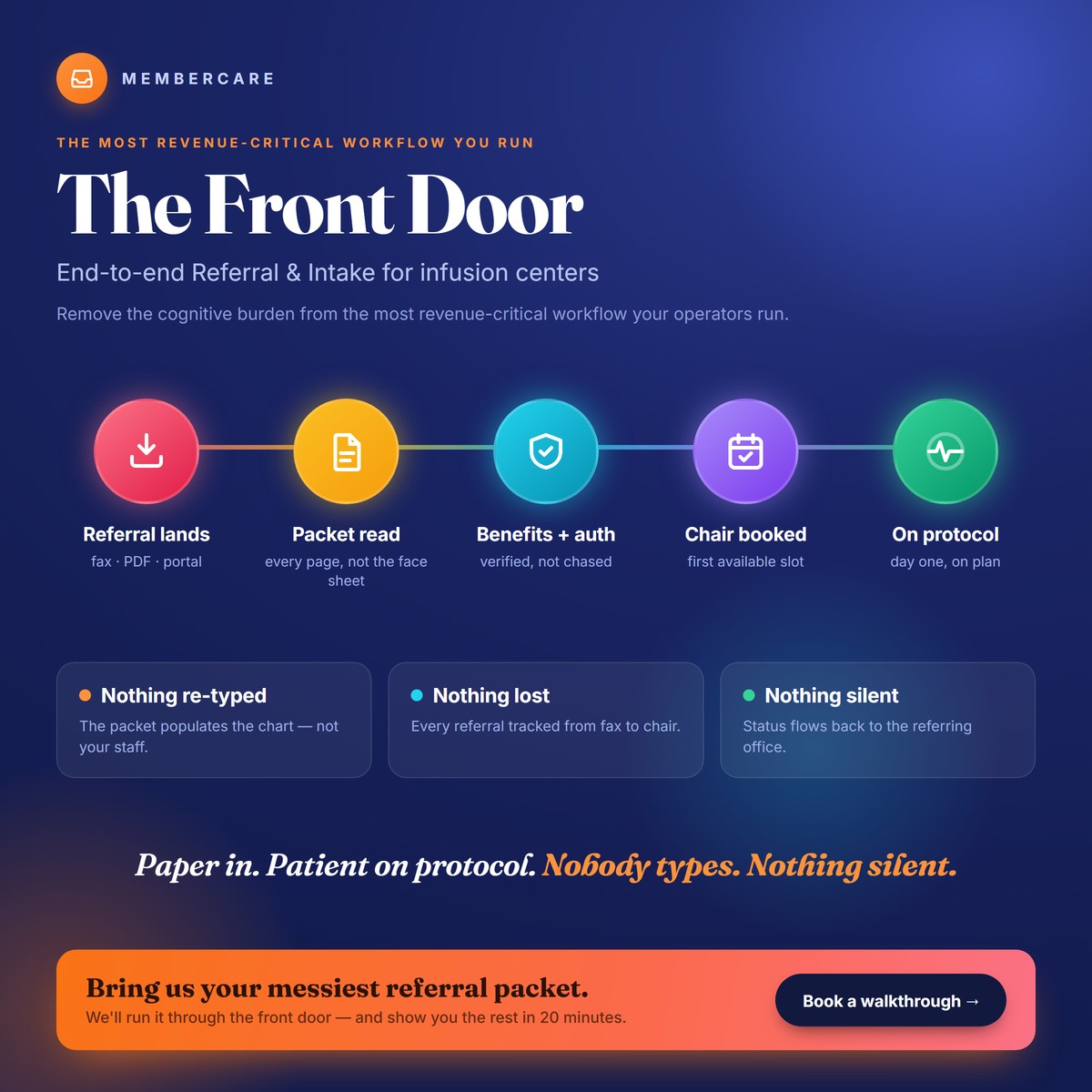
Paper in.
Patient on protocol.
Nobody types.
Nothing silent.
While the world debates whether AI can help healthcare, we have been quietly building for the people who actually carry it.
Not the headlines. The healthcare workers. The intake coordinator with forty referrals open and no way to rank them. The nurse chasing the same authorization for the third time because nobody wrote down what happened on the first two calls. The scheduler holding six things in their head because the system holds none of them.
They do not need another dashboard. They have dashboards. What they need is the weight taken off.
So we started at the front door.
Why the Front Door, and Not the Diagnosis
Most conversations about AI in healthcare start at the most dramatic possible place: can a model read the scan, catch the tumor, outperform the physician. Those are real questions, and serious people are working on them.
They are also not what is breaking your week.
The best time-and-motion evidence we have on ambulatory practice found physicians spending 27% of their day on direct clinical face time and 49.2% on the electronic health record and desk work — and then another one to two hours of documentation at home each night. The American Medical Association's 2025 prior-authorization survey put the number on the other side of the desk: an average of 40 prior authorizations per physician per week, consuming 13 hours, with 95% of respondents reporting that the process delays care. And when a referral does go out the door, a large analysis of referral scheduling attempts found that only about a third resulted in a documented completed appointment.
Read those three numbers together and a picture forms that has nothing to do with diagnostic accuracy. The scarce resource in specialty care is not clinical judgment. It is attention — and we spend most of it on clerical work that no one went to school for.
Sources listed at the end of this article. We have deliberately used only figures we could trace to a primary source.
The front door is where that attention gets spent first and worst. A referral arrives — a fax, a PDF, a portal message, sometimes a phone call and a promise. Someone retypes it into the practice management system. Someone else starts benefits. Someone calls about the authorization. Someone finds a chair. The referring office never hears back. Three weeks later the patient started somewhere else, and nobody in the building can say precisely why.
That is not a staffing problem, and hiring will not fix it. It is a front-door problem — and it is simultaneously the most revenue-critical and least automated workflow most specialty centers run.
Two Failures Live Here: The Typing and the Silence
The first failure is the obvious one. A referral packet is a single clinical instruction, written by one physician, about one person. It then gets keyed by hand into four or five systems by three or four people, none of whom can see what the others did. Every one of those keystrokes is an opportunity for a transposed digit, a dropped page, a weight that was on page three of the fax and never made it into the chart.
The second failure is quieter, and when we talk to operators it is the one they raise first.
The part that hurts most isn't the typing. It's the silence. A referral goes in, and nobody — including the referring office — can say where it stands.
Silence is not a neutral state. A referral with no status is a referral nobody is working, and the patient sitting inside it is aging in a queue that has no clock. The referring physician stops sending, not because anyone was rude, but because they got tired of not knowing. And the center finds out about the leak the way centers always do: in a volume report, one quarter late.
Here is the same queue, seen two ways.
Illustrative queue states, no real patient data. Notice what did not change: the right-hand panel does not make anything faster by magic. It makes the work visible, which is the precondition for making it faster.
What We Believe the Front Door Should Do
We are deliberately writing this as a belief rather than a boast. Some of what follows is running, some of it is being built, and we would rather tell you which is which in a conversation than blur the line in a blog post. But the target is not ambiguous to us:
Paper in. Patient on protocol. Nobody types. Nothing silent.
Two of those five stages are where AI earns its keep, and they are not the ones people expect.
“Nobody types” means the packet populates the record — not your staff
A referral packet is unstructured on purpose: it was written by a human for a human. Reading it — all of it, including the page four addendum with the lab cadence and the handwritten note about the caregiver's phone number — and turning it into structured, reviewable intake is exactly the kind of work modern language models are genuinely good at, and exactly the kind of work that consumes the most experienced coordinator in your building.
The important design choice is what happens next. The output is not a decision. It is a draft with its sources attached — every field traceable back to the page it came from, so a human can confirm it in seconds instead of transcribing it in minutes. What is missing gets flagged the day the packet arrives, not the week before the first infusion when someone finally notices there is no amyloid confirmation on file.
“Nothing silent” means status is a first-class object
The harder half is the follow-up, because it is not a data problem at all — it is an accountability problem wearing a data problem's clothes. A front door that works treats silence as a defect. Every referral has a state, an owner, an age and a next action. Nothing sits without one. And critically, the status flows back to the referring office without anyone picking up a phone, because the referring office is the customer that keeps the door open.
None of this is glamorous. All of it is compounding. A center that reliably closes the loop gets more referrals from the same physicians next quarter, which is a growth strategy that costs nothing and cannot be copied by a competitor with a bigger marketing budget.
One Front Door Beats Five Best-in-Class Ones
Here is the part that matters most, and the part the market keeps getting wrong.
Every stage of that pipeline already has an excellent point solution attached to it. There is a very good referral-capture tool. There is a very good eligibility engine. There is a very good prior-authorization vendor, a very good chair-scheduling optimizer, a very good denials-management layer. Centers bought them one at a time, and every single purchase was rational.
And the sum of all those good decisions is a workflow where no system, and frequently no person, can answer the only question that matters: where is this patient right now, and what is she waiting on?
Point solutions optimize steps. The patient does not experience steps. The patient experiences the seams — and the seams are precisely where nobody's software is accountable. A best-in-class extraction tool that hands a perfect data set to a system that cannot tell the scheduler an imaging gate is unmet has not improved the outcome; it has produced excellent input for a failure that happens two vendors downstream.
- Every handoff is a re-entry point — and a chance to drop a page
- Status lives in five queues, so it effectively lives nowhere
- A missing document surfaces at the stage that needs it, not the stage that received it
- Protocol dependencies are documented in one system, enforced in none
- Escalation means a person who knows all five logins — usually your most experienced nurse
- When the front door leaks, every vendor's metrics still look excellent
- The packet is read once and carries forward — nothing is retyped at a boundary
- One state per referral, visible to intake, nursing, scheduling and the referring office
- Missing documents surface on arrival, weeks before they block a chair
- Protocol dependencies — labs, imaging gates, titration — are enforced, not just recorded
- Escalation is built in, because the system knows what has been sitting and for how long
- One accountable answer to “where is this patient?” — and one throat to clear when it's wrong
This is not an argument that integrated software is inherently better engineered. Frequently it is not — a focused vendor with one problem will usually out-feature a platform on that problem, and honest platform companies should admit it. The argument is narrower and harder to dismiss: the value in the front door is created almost entirely at the seams, and a seam is by definition the one thing no point solution can own.
You cannot buy an integration layer for six vendors. You can only staff one — which is exactly what centers are doing today, with the most experienced person in the building.
Nobody sets out to build a fragmented stack. It accretes, one reasonable purchase at a time, until the workflow is held together by a human who remembers everything — and then that human takes a job somewhere else.
We wrote a longer piece on how that fragmentation reaches all the way into clinical safety in the anti-amyloid era: Six Vendors, One Patient.
The Case for Quiet AI
We are an AI company. We would just rather not act like one.
The healthcare AI market has spent several years optimizing for demonstrability — things that look extraordinary in a fifteen-minute demo and then need a champion, a training program and a change-management consultant to survive contact with a Tuesday. Meanwhile the actual bottleneck sits in an inbox, and it is boring, and boring does not present well at a conference.
The most useful AI in a specialty center should be almost invisible to the people it helps. Nobody should have to learn a new vocabulary, open a new tab, or “engage with the assistant.” The referral simply arrives more complete than it used to. The gap gets flagged on day one instead of week three. The status is there when the referring office asks. Five things that used to require a person to remember them now do not.
That is the standard we hold ourselves to, and these are the rules we work by:
Reading, extracting, cross-checking, reconciling, reminding, drafting. Not deciding who gets treated, when, or with what. The line is not blurry and we do not intend to blur it.
If a value lands in the record, a human can see where it came from and confirm or correct it. An extraction you cannot audit is a liability wearing an efficiency costume.
Illegible page, contradictory dose, missing document, ambiguous diagnosis code: those go to a person with the specific question attached. Confident nonsense is the failure mode that ends these programs.
Anything sitting without an owner or a next action is an exception to be surfaced, not a row to be scrolled past. The system should be the thing that remembers, so people do not have to.
Not features shipped, not adoption metrics, not minutes spent in our software. If the coordinator's day did not get lighter, we did not do the job — whatever the dashboard says.
The fragmented specialty stack got that way one reasonable purchase at a time. We are not interested in being the seventh login on the intake coordinator's monitor.
What Changes on a Tuesday
Strategy documents are easy. The test of any of this is what a particular person's afternoon feels like.
Forty referrals open. No way to tell which are one document away from scheduling and which have been dead for a week. Triage happens by whoever called most recently.
After: the queue is ordered by what is actually blocking each patient. The one missing document is named. The dead ones are visible instead of quietly aging.
Chasing the same authorization for the third time, because the first two calls left no trace anyone else can find. Re-reading a four-page fax to confirm a titration schedule.
After: the authorization has a reference number, a submission date and a follow-up already scheduled. The protocol's requirements are on the record, not in the fax.
Holding six constraints in their head: the auth, the labs, the imaging gate, the chair, the pharmacy lead time, the patient's ride. The system holds none of them.
After: the constraints live in the system. A slot that violates one of them is not offered, and the reason it is not offered is legible.
Notice that none of these people were replaced, retrained, or asked to trust a black box. They were just relieved of the parts of their job that never required a human in the first place — which, in our experience, is what people actually mean when they say they want AI in their practice.
Why This Is Worth Doing Properly
There is a version of this argument that is purely about margin, and it is a good argument. Referrals that never convert are patients someone already paid to acquire. Denials that trace back to a document missing at intake are revenue lost to a five-minute failure that happened weeks earlier. The administrative opportunity here is enormous and well documented: industry-wide, the most recent CAQH Index attributes roughly $258 billion in annual costs already avoided through automation, with about $21 billion still on the table.
But margin is not the reason we started here, and it is not the reason that matters most in specialty care.
In infusion and specialty settings, front-door delay is a clinical variable. A cohort study of infusible medications found prior authorization pushing median time to treatment to 31 days, and to 50 days when the request was initially denied — and 82% of those denials were eventually overturned, meaning the delay bought nothing. Across more than two million patients with common cancers, longer time from diagnosis to treatment initiation was associated with measurably higher mortality. And in the anti-amyloid era, where eligibility windows are measured in months of cognitive decline and imaging gates sit between doses, six weeks lost to a document that existed the whole time is not an inconvenience. It is a different outcome.
The front door is the only place in the workflow where an administrative fix and a clinical outcome are the same intervention.
That is why we did not start with the scan.
We're Not Here to Score
Good players score goals. Great players — Messi, Mbappé, Bellingham, Kane — change the game. They change where everyone else has to stand.
Healthcare software has spent a long time scoring: a better form, a faster portal, a cleaner report, a point solution for each step of a workflow that nobody owns end to end. Each purchase rational, and the sum of them a building where the most experienced nurse on staff is the integration layer.
We would rather change where the door is.
Paper in. Patient on protocol.
Nobody types. Nothing silent.
If you run intake or patient access at an infusion or specialty center, we would genuinely like to know: where does your front door leak first — the packet, the auth, or the follow-up? We are building toward an answer, and the operators who have told us where it hurts have shaped it more than any roadmap has.
We're building this with operators, not at them.
We are working with a deliberately small number of partners on the front door, because the only way to get this right is to build it next to the people who run it every day. If your work touches referral, intake or patient access, there is a version of this conversation worth having.
Bring us your messiest referral packet. We'll walk you through exactly what we would do with it — every page, every missing document, every point where it would otherwise go quiet. Twenty minutes, no slides, and we'll tell you plainly which parts are running today and which we're still building.
Not ready to talk to a vendor? That's a legitimate answer. We'd still like to hear where your front door leaks first — the packet, the auth, or the follow-up. The operators who have told us where it hurts have shaped this more than any roadmap has.
Sources & Further Reading
- Sinsky C, Colligan L, Li L, et al. “Allocation of Physician Time in Ambulatory Practice: A Time and Motion Study in 4 Specialties.” Annals of Internal Medicine, 2016;165(11):753–760 — 27.0% direct clinical face time vs. 49.2% EHR and desk work, plus 1–2 hours of after-hours documentation.
- American Medical Association. 2025 AMA Prior Authorization Physician Survey (n=1,000) — an average of 40 prior authorizations per physician per week consuming 13 hours; 95% report care delays.
- “Closing the Referral Loop” referral-completion analysis, 2018 — of 103,737 referral scheduling attempts, 36,072 (34.8%) resulted in a documented completed appointment.
- NSI Nursing Solutions. 2025 National Health Care Retention & RN Staffing Report (450 hospitals, 37 states) — 16.4% staff RN turnover; $61,110 average cost to replace one staff RN.
- CAQH. 2025 CAQH Index (2024 data) — approximately $258B in annual administrative costs already avoided through automation, with roughly $21B in remaining opportunity.
- “Treatment Delays Associated With Prior Authorization for Infusible Medications: A Cohort Study.” Arthritis Care & Research, 2020;72(11) — median 31 days to treatment vs. 27 without PA; 50 days when initially denied; 82% of denials overturned.
- Cone EB, Marchese M, Paciotti M, et al. “Assessment of Time-to-Treatment Initiation and Survival in a Cohort of Patients With Common Cancers.” JAMA Network Open, 2020;3(12):e2030072 — n=2,241,706; increasing time to treatment associated with higher mortality.
- Golla V, Zuckoff A, MacPhail L, Tam J, Rariy C. “Tangle of Tech: How Community Oncology Practices Can Successfully Navigate the Health Technology Landscape.” The American Journal of Managed Care, October 2024 — on patchworks of disconnected, siloed systems requiring human effort to tie together.
A note on sourcing: figures widely circulated in this market — referral-leakage percentages, packet-extraction accuracy claims, chair-utilization benchmarks — frequently cannot be traced to a primary source. We have omitted them rather than repeat them. Queue states shown in this article are illustrative and contain no patient data.
Keep reading, or keep in touch.
We write about the operational and clinical seams in specialty care roughly monthly — no product announcements, no gated PDFs. The companion piece to this one is on how fragmentation reaches all the way into clinical safety in the anti-amyloid era.
Read Six Vendors, One Patient Follow us on LinkedIn