Invention sprinted ahead.
Administration didn't.
The protocol changes.
The discipline doesn't.
I have spent most of my career in healthcare, and most of that in oncology. Along the way I built an oncology-specific EHR, and I came to understand the nuances of this space the slow way — one edge case at a time.
Here is what strikes me in 2026. The world has become extraordinary at inventing complex therapies. Cancer regimens that combine four drugs on a fourteen-day clock. Anti-amyloid infusions that were science fiction a decade ago. Biologics for rheumatoid arthritis and autoimmune disease. Cell and gene therapies that edit the patient. Medicine's ability to create treatment has sprinted ahead of almost everything around it.
Administering those treatments is a different story. And here is the part almost nobody talks about: whether the diagnosis is cancer, Alzheimer's or rheumatoid arthritis, administration looks strikingly similar.
We Got Brilliant at Inventing. Not at Administering.
Two clocks run in this industry, and they run at wildly different speeds. One is the pace of discovery, and it is astonishing. The other is the pace at which the average specialty center can safely, reliably and profitably deliver what discovery produces — and that one has barely moved.
The distance between those two bars is where patients wait, revenue leaks and staff burn out. Discovery is a science problem, and we are winning it. Administration is an execution problem, and most places are still losing it — not for lack of expertise, but for lack of a system built to carry the discipline.
Sources listed at the end of this article. We have used only figures we could trace to a primary source, and phrased the rest as what it is: judgment.
The Same Pattern, Wearing Different Names
Strip away the disease labels and the drug names, and delivering a complex therapy is the same four-part discipline every single time:
- A protocol that runs for months or years, in cycles, with rules about sequence, spacing and dose.
- Pre-checks before every dose — labs, vitals, imaging, symptoms — that decide whether today's dose is safe to give.
- Safety monitoring during administration, and watching the patient in the gaps between visits when nobody is in the room.
- Authorization and documentation that quietly decide whether anyone actually gets paid for any of it.
That pattern repeats across the world, in oncology suites and memory clinics and rheumatology infusion bays that have never compared notes. The therapies could not be more different. The discipline of delivering them is nearly identical. Look at three of them side by side.
scroll to compare all three
Illustrative, and simplified for clarity — not clinical guidance. Read down a column and you see three different diseases. Read across a row and you see the same job. The drug names in the header change from clinic to clinic; the four rails beneath them do not.
A center that has solved this discipline for one therapy has quietly solved most of it for the next one — if, and only if, the discipline lives in a system instead of in the heads of the people who happen to run that clinic today.
The Hurdles Begin the Moment Administration Starts
I have listened to a lot of clinical experts over the years — including some very well-known oncologists — and on one point they are unanimous. An expert clinician can pick the right therapy in their sleep. That is not where the challenge lies. The picking is the part medicine trained them exhaustively to do.
The hurdles begin the moment administration starts — and then they repeat, for every cycle after. The pre-check that has to clear before the next dose. The imaging gate that sits between two infusions. The authorization that expires halfway through a year-long protocol. The symptom, reported between visits, that should change what happens at the next one. None of these is hard in isolation. All of them together, times a full schedule, times every patient on it, is a coordination problem that no amount of clinical brilliance was ever meant to solve by hand.
Picture a single infusion room on one ordinary day — a handful of chairs, and visits that run anywhere from thirty minutes to eight hours, each with its own pre-checks to clear, its own monitoring while the drug goes in, its own paperwork behind it.
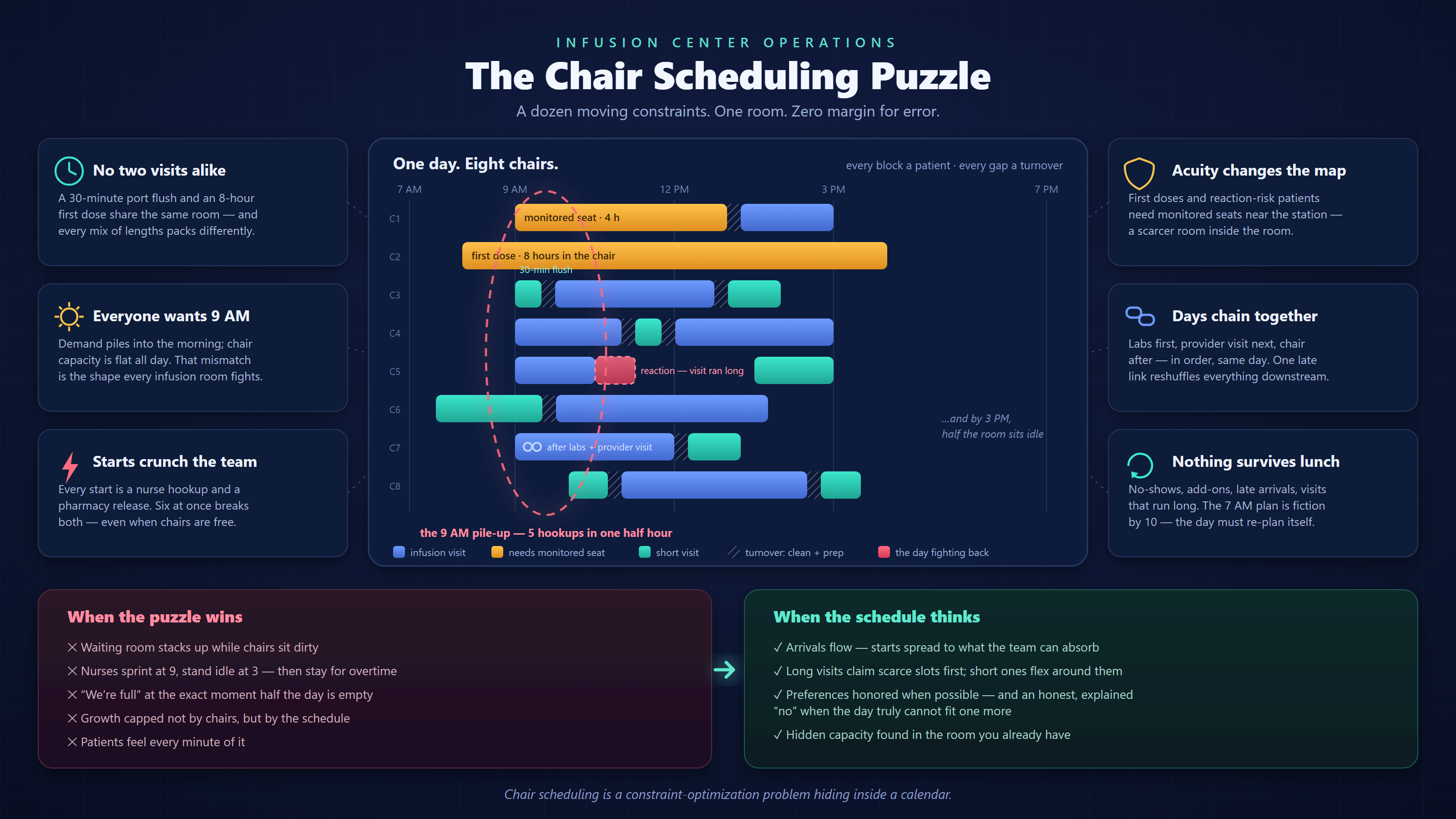
Now multiply that single day by a protocol that runs for a year, by an authorization that has to be alive on every one of those days, by a pre-check that has to clear before every single dose. That is administration. It is not glamorous, it does not present well at a conference, and it is exactly where complex therapy succeeds or fails.
Choosing the therapy is a decision. Delivering it is a discipline that has to hold up for months — and a decision made once is a very different thing from a discipline sustained a hundred times.
Point Solutions, Spreadsheets and Heroics
So how does most of the world run this discipline today? On point solutions, spreadsheets and heroics — a landscape littered with land mines.
There is a very good scheduling tool. A very good eligibility engine. A very good prior-authorization vendor, a very good documentation layer. Each was bought one at a time, and every single purchase was rational. But the therapy does not travel through tools; it travels through a patient, across months, and the patient experiences the seams between those tools — the places where no software is accountable and a person has to remember. When a program depends on one nurse holding the whole protocol in her head, it is one resignation away from a very bad quarter.
- The discipline lives in one experienced person's head — and heads go home at five
- A pre-check that isn't done doesn't stop the dose; it surfaces at the chair
- An authorization expires mid-protocol and nobody is watching the clock
- A symptom reported between visits lands in an inbox, not the next decision
- Every disease is re-solved from scratch, because nothing carried over
- When it breaks, every individual tool's metrics still look excellent
- The discipline lives in the system, so it survives a resignation and a Tuesday
- Pre-checks are enforced gates — a dose that isn't safe to give isn't offered
- Authorizations have a state, an expiry and a next action, weeks ahead
- Between-visit signals flow into the next dose decision, not a dead inbox
- Solve the discipline once; the next therapy inherits it by configuration
- One accountable answer to “where is this patient, and what's blocking them?”
We wrote at length about how that fragmentation reaches all the way into clinical safety in the anti-amyloid era — Six Vendors, One Patient — and about the front door every one of these patients passes through first, in Nobody Types. Nothing Goes Silent.
What We Built: An Execution Engine, Disease-Agnostic by Design
That is why we built MemberCare. Not another disease app, and not another dashboard for someone to check. An execution engine for complex therapy administration — a system whose job is to carry the four-part discipline for you, cycle after cycle, and to make the therapy the thing it tracks rather than the tool.
Disease-agnostic is not a marketing posture here; it is the whole architectural bet. Because the protocol changes and the discipline doesn't, we built for the discipline. The same engine that enforces a pre-check before a FOLFOX cycle enforces the surveillance MRI before an anti-amyloid infusion and the infection screen before a biologic. A new regimen is a configuration, not a rebuild.
Cycles, spacing, sequence and dose rules live in the system as structure, not as a note in someone's memory. The plan for month nine is knowable in month one — and the same model describes a chemo regimen, an infusion series and a biologic.
Labs, vitals, imaging and symptom checks are dependencies the schedule respects. A dose that isn't yet safe to give is simply not offered, and the reason it isn't offered is legible to everyone who needs it — before the patient is in the chair.
A protocol doesn't pause when the patient goes home. Symptoms, vitals and device data reported between doses flow into the next decision instead of a dead inbox — and the ones that matter escalate to a person with the specific question attached.
The paperwork that decides whether anyone gets paid isn't a separate project bolted on at the end. It tracks the protocol in real time — auth state, expiry, the documentation each cycle needs — so revenue integrity is a property of the workflow, not a scramble after it.
In plain terms: an expert already knows what to give. The engine's job is everything that happens after that decision — the part that used to require heroics, and shouldn't.
A Status Quo Nobody Should Have to Accept
Complex therapy is one of the great achievements of our era. The fact that delivering it still runs on spreadsheets and heroics — that a year-long, life-altering treatment can be knocked off course by a document that existed the whole time, or an authorization nobody was watching — is not an unfortunate detail. It is a status quo nobody should have to accept, least of all the patient sitting inside it.
The protocol will keep changing. New molecules, new mechanisms, new modalities — the invention clock is not slowing down, and it shouldn't. The discipline of administering them safely, on schedule and on the books will not change nearly as fast. So build for the part that holds still.
The protocol changes.
The discipline doesn't.
If you deliver complex therapies — oncology, neurology, rheumatology or beyond — or you are building in this space and see the same gap, we would genuinely like to compare notes. Where does administration break first in your world: the pre-check, the monitoring, or the authorization?
The protocol is yours. The discipline, we can carry together.
We are building this with operators, not at them — and with a deliberately small number of partners, because the only way to get an execution engine right is to build it next to the people who run administration every day. If your work touches complex therapy delivery, there is a version of this conversation worth having.
Bring us your hardest protocol. We'll walk you through exactly how the engine would carry it — every cycle, every pre-check gate, every point where an authorization or a between-visit symptom would otherwise go quiet. Twenty minutes, no slides, and we'll tell you plainly which parts are running today and which we're still building.
Not ready to talk to a vendor? Fair enough. We'd still like to hear where administration breaks first in your world — the pre-check, the monitoring, or the authorization. The operators who have told us where it hurts have shaped this more than any roadmap has.
Sources & Further Reading
- U.S. Food & Drug Administration, Center for Drug Evaluation and Research (CDER). Novel Drug Approvals annual reports — CDER has cleared roughly 50 novel drugs per year across recent years (e.g., 55 in 2023, 37 in 2022, 50 in 2021, 53 in 2020), a figure that excludes the many cell, gene and biologic therapies reviewed by CBER.
- American Medical Association. 2025 AMA Prior Authorization Physician Survey (n=1,000) — an average of 40 prior authorizations per physician per week consuming 13 hours; 95% report the process delays care.
- “Treatment Delays Associated With Prior Authorization for Infusible Medications: A Cohort Study.” Arthritis Care & Research, 2020;72(11) — median 31 days to treatment vs. 27 without a prior authorization; 50 days when initially denied; 82% of denials eventually overturned.
- Cone EB, Marchese M, Paciotti M, et al. “Assessment of Time-to-Treatment Initiation and Survival in a Cohort of Patients With Common Cancers.” JAMA Network Open, 2020;3(12):e2030072 — n=2,241,706; increasing time from diagnosis to treatment associated with higher mortality.
- Prescribing information for lecanemab (Leqembi) and infliximab (Remicade), and NCCN/ASCO administration references — used to characterize dosing cadence, ARIA MRI surveillance, and pre-treatment screening. The administration matrix in this article is illustrative and simplified for clarity; it is not clinical guidance.
A note on sourcing: figures widely repeated in this market — referral-leakage rates, utilization benchmarks, staffing multipliers — frequently cannot be traced to a primary source. We have omitted them rather than repeat them. The three therapies above are real and their delivery patterns are real; the specific cycle details are compressed for readability and contain no patient data.
Keep reading, or keep in touch.
We write about the operational and clinical seams in complex therapy roughly monthly — no product announcements, no gated PDFs. The companion pieces to this one are on how fragmentation becomes a safety problem, and on the front door every therapy patient passes through first.
Read Six Vendors, One Patient Follow us on LinkedIn